

The Damara red-billed hornbill is a species of hornbill in the family Bucerotidae. It is found in southwest Angola and northern Namibia. All five red-billed hornbills were formerly considered conspecific.
Region
Southwestern Africa
Typical Environment
Occurs in northern Namibia and adjoining southwest Angola, primarily in dry savanna, mopane woodland, thornveld, and semi-desert scrub. It favors open to lightly wooded habitats with scattered trees for nesting cavities. Riverine fringes and dry washes are used for shade and foraging in hotter months. It adapts well to low-intensity farmland and villages where trees remain. Availability of natural cavities and seasonal insect abundance strongly influence local density.
Altitude Range
0–1800 m
Climate Zone
Arid
Ease of Keeping
Beginner friendly: 2/5
Damara red-billed hornbills often forage on the ground and are known to sometimes associate with dwarf mongooses, benefiting from shared vigilance. Like other hornbills, the female seals herself inside a tree cavity during nesting, leaving only a narrow slit through which the male feeds her and the chicks. Their bright red bill and white-spotted wings make them easy to distinguish in their arid savanna habitats.

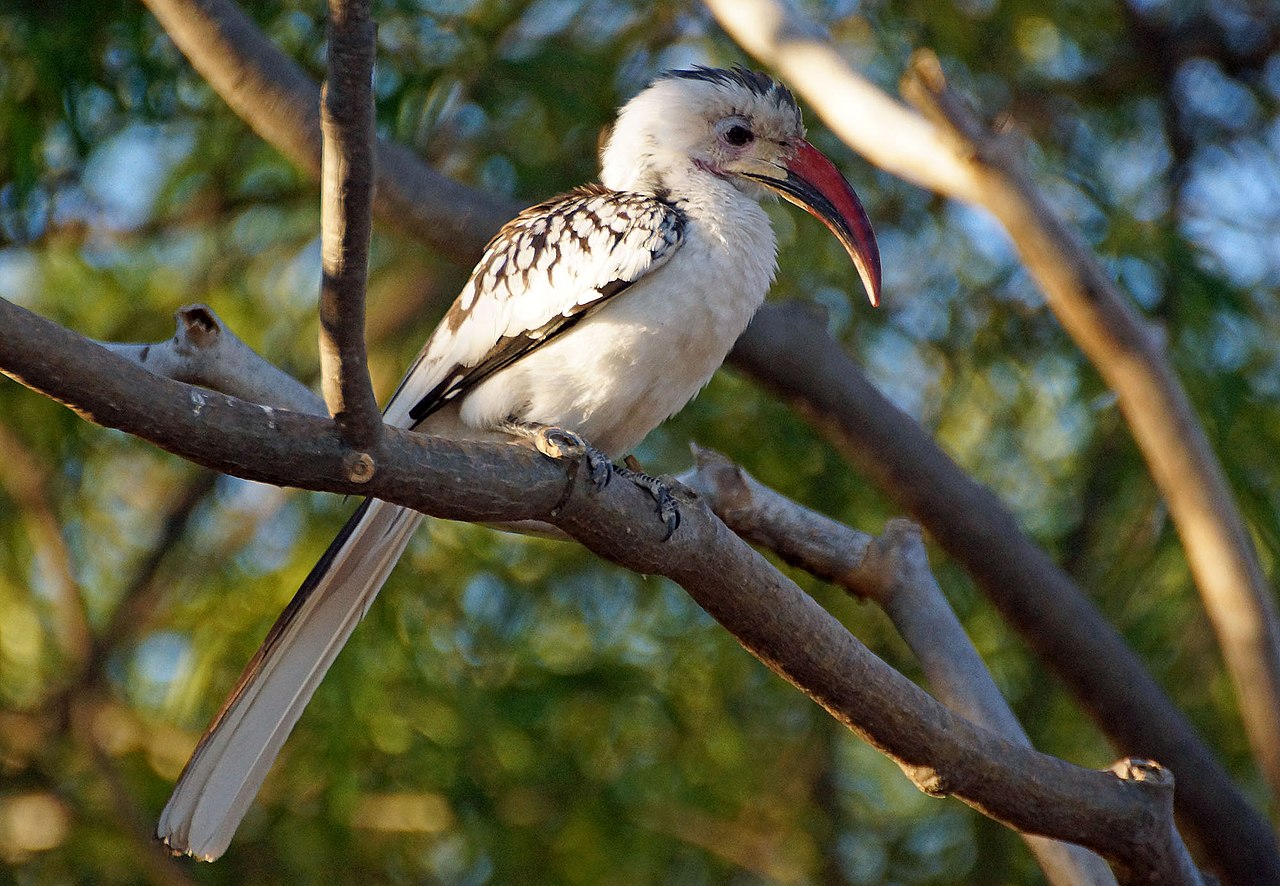
In Kunene Region, Namibia
Temperament
social and active
Flight Pattern
short rapid wingbeats with brief glides
Social Behavior
Usually seen in pairs or small family groups, often foraging on the ground under trees. Pairs are monogamous and nest in natural cavities; the female seals the entrance with mud and droppings, relying on the male for food until the chicks are large. They sometimes join mixed-species foraging parties, including with dwarf mongooses.
Migratory Pattern
Resident
Song Description
Calls are a series of clucking and piping notes, often accelerating into a chattering sequence. They also give sharp contact calls while moving through scrub and soft whistles during pair interactions.
Plumage
Grey-brown upperparts with prominent white spots on the wing coverts, white underparts, and a white throat. The tail is dark with white outer feathers, and the head and neck are pale grey with fine streaking.
Diet
Feeds mainly on insects such as termites, beetles, and grasshoppers, which are gleaned from the ground and low vegetation. It also eats spiders, small lizards, and occasional nestling prey when available. Fruits, seeds, and berries are taken seasonally, especially when insect prey is scarce. Around human settlements, it may opportunistically pick scraps.
Preferred Environment
Forages along the ground beneath trees and shrubs, in open woodland edges, and around dry riverbeds. Frequently searches among leaf litter, fallen branches, and at termite mounds. Will use lightly cultivated fields and village margins if cover and trees are present.


