

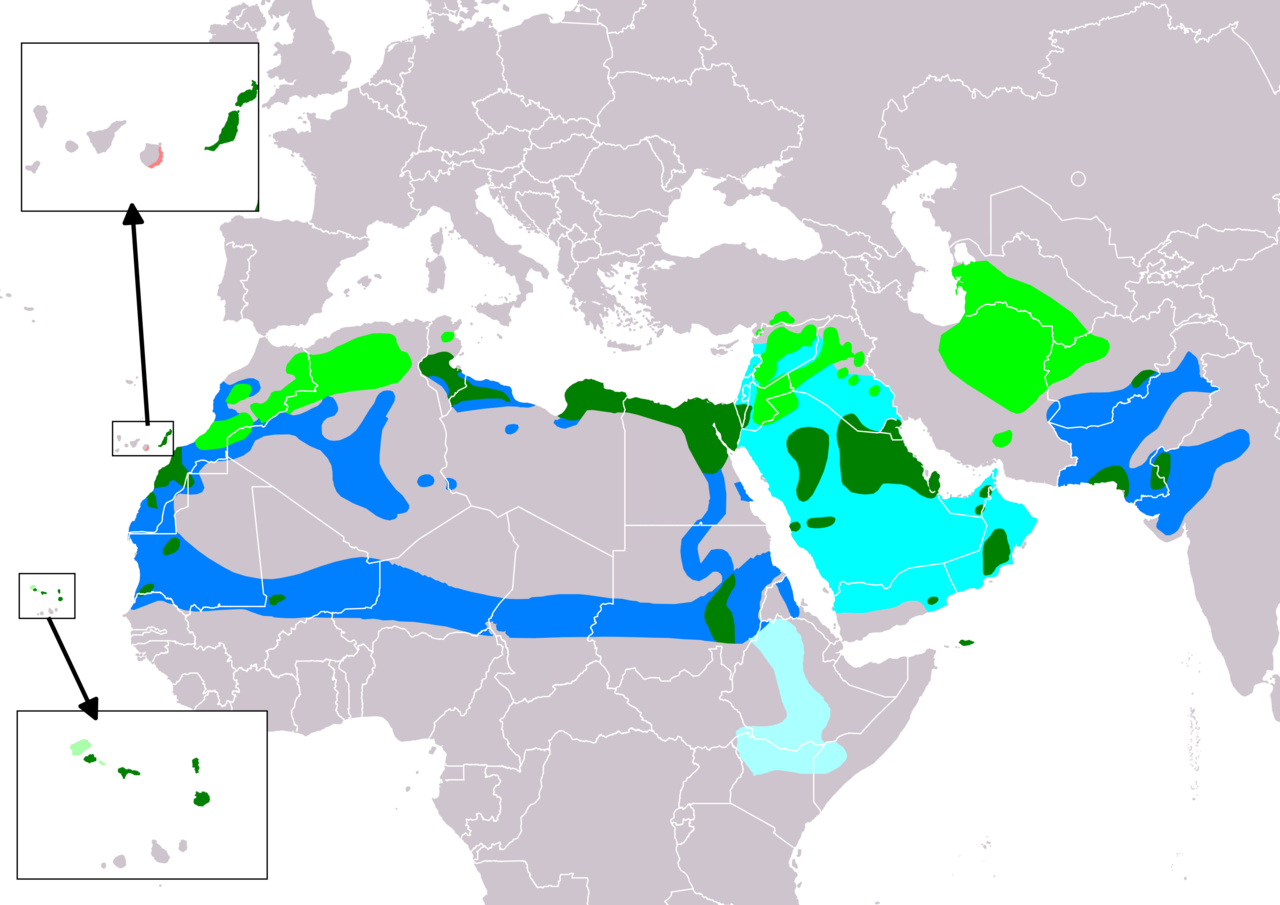
The cream-colored courser is a species of wader in the pratincole and courser family, Glareolidae. Both parts of the scientific name derive from Latin cursor, "runner", from currere, "to run" which describes their usual habit as they hunt their insect prey on the ground in dry open semi-desert regions of the Middle East and northern Africa.
Region
North Africa and the Middle East
Typical Environment
This species inhabits open semi-deserts, gravel plains, sandy flats, and sparsely vegetated steppe from the Sahara and Sahel through the Arabian Peninsula to parts of the Middle East. It favors hard, stony substrates with scattered low shrubs and minimal ground cover. Agricultural fallows, coastal flats, and salt pans are also used when suitably open. It avoids dense vegetation and rugged terrain, selecting areas with wide visibility for predator detection. Some populations wander or move seasonally in response to rainfall and prey availability.
Altitude Range
Sea level to 1500 m
Climate Zone
Arid
Ease of Keeping
Beginner friendly: 1/5
Named for its running habit, the cream-colored courser chases insect prey on foot across open, arid ground. Its pale sandy plumage provides excellent camouflage against desert substrates. Adults perform distraction displays to draw predators away from their shallow ground nest. In flight, a striking white wing bar contrasts with dark primaries.


Adult bird photographed in Dibba, United Arab Emirates

Eggs collected from Tunisia, in the collection of the Muséum de Toulouse
Temperament
wary and alert
Flight Pattern
short rapid wingbeats with low, swift, level flight
Social Behavior
Usually seen singly, in pairs, or small loose groups; may gather in larger flocks where food is abundant. Nests are simple scrapes on open ground with excellent camouflage. Both sexes incubate and care for the young, often using distraction displays. Breeding timing is flexible and can follow rains in arid regions.
Migratory Pattern
Partial migrant
Song Description
Generally quiet; gives sharp, piping calls and soft trills, especially during display or in flight. Alarm calls are quick, high-pitched notes delivered while running or taking off.
Plumage
Smooth, pale sandy-buff upperparts and breast with a paler belly; dark flight feathers with a clean white wing bar visible in flight; short tail and long legs.
Diet
Primarily feeds on insects such as beetles, grasshoppers, ants, and termites, taken by sight. It employs a run-and-stop technique, darting to snatch prey from the surface. Occasionally consumes small arthropods and other invertebrates. Opportunistic foraging intensifies after rains when insect numbers peak.
Preferred Environment
Open, flat ground with sparse vegetation where visibility is high, including desert pavements, gravelly plains, and dry fields. It often forages along the edges of salt pans and in lightly grazed steppe.


