
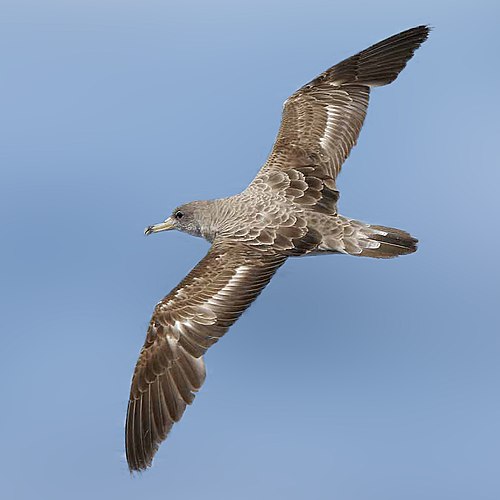
Cory's shearwater is a large shearwater in the seabird family Procellariidae. It breeds colonially on the archipelago of the Azores in the eastern Atlantic. Outside the breeding season it ranges widely in the Atlantic. It was formerly considered to be conspecific with Scopoli's shearwater.
Region
North Atlantic Ocean
Typical Environment
Breeds on oceanic islands of the Northeast Atlantic, nesting on cliffs, rocky islets, and vegetated slopes where it digs burrows or uses crevices. Outside the breeding season it disperses widely across the North Atlantic, commonly to the western Atlantic off North and South America and to productive upwelling zones off West Africa. It forages mostly over continental shelf edges and oceanic fronts where prey is concentrated. Near colonies it commutes to rich feeding areas and may gather in large rafts on the water.
Altitude Range
Sea level to 100 m
Climate Zone
Subtropical
Ease of Keeping
Beginner friendly: 1/5
Cory's shearwater is a long-lived pelagic seabird that breeds colonially on islands of the Northeast Atlantic, especially the Azores, Madeira, and Canary Islands. It was formerly treated as conspecific with the Mediterranean-breeding Scopoli's shearwater but is now recognized as distinct. Using dynamic soaring, it ranges widely across the Atlantic outside the breeding season. Adults often show strong site fidelity, returning to the same burrow year after year.


Temperament
social and active
Flight Pattern
soaring glider
Social Behavior
Highly colonial, nesting in burrows or rock crevices on islands; adults return mostly at night to avoid predators. Typically monogamous with long-term pair bonds and strong natal philopatry. Usually lays a single egg per year and both parents share incubation and chick-rearing duties.
Migratory Pattern
Seasonal migrant
Song Description
At colonies after dark it gives loud, cackling and wailing calls, with sexes differing slightly in tone and cadence. At sea it is generally silent, vocalizing mainly near breeding sites during nocturnal activity.
Plumage
Upperparts grey-brown with darker flight feathers; underparts mostly white with dusky shading at the sides and a broad dark border on the underwing framing a pale panel. Head pale greyish with a slightly darker cap and nape. Feathers appear smooth and sleek, adapted for pelagic life.
Diet
Feeds mainly on small schooling fish and squid, supplemented by crustaceans and occasionally offal from fishing vessels. Takes prey by surface seizing, shallow plunge-dives, and pattering take-offs to grab items near the surface. Often associates with tuna, dolphins, or feeding seabird flocks that drive prey upward. Will follow trawlers and longliners to scavenge discards.
Preferred Environment
Most often forages over shelf breaks, oceanic fronts, and upwelling zones where prey is aggregated. Usually far from land outside the breeding season, but may forage closer to colonies during chick-rearing.


