
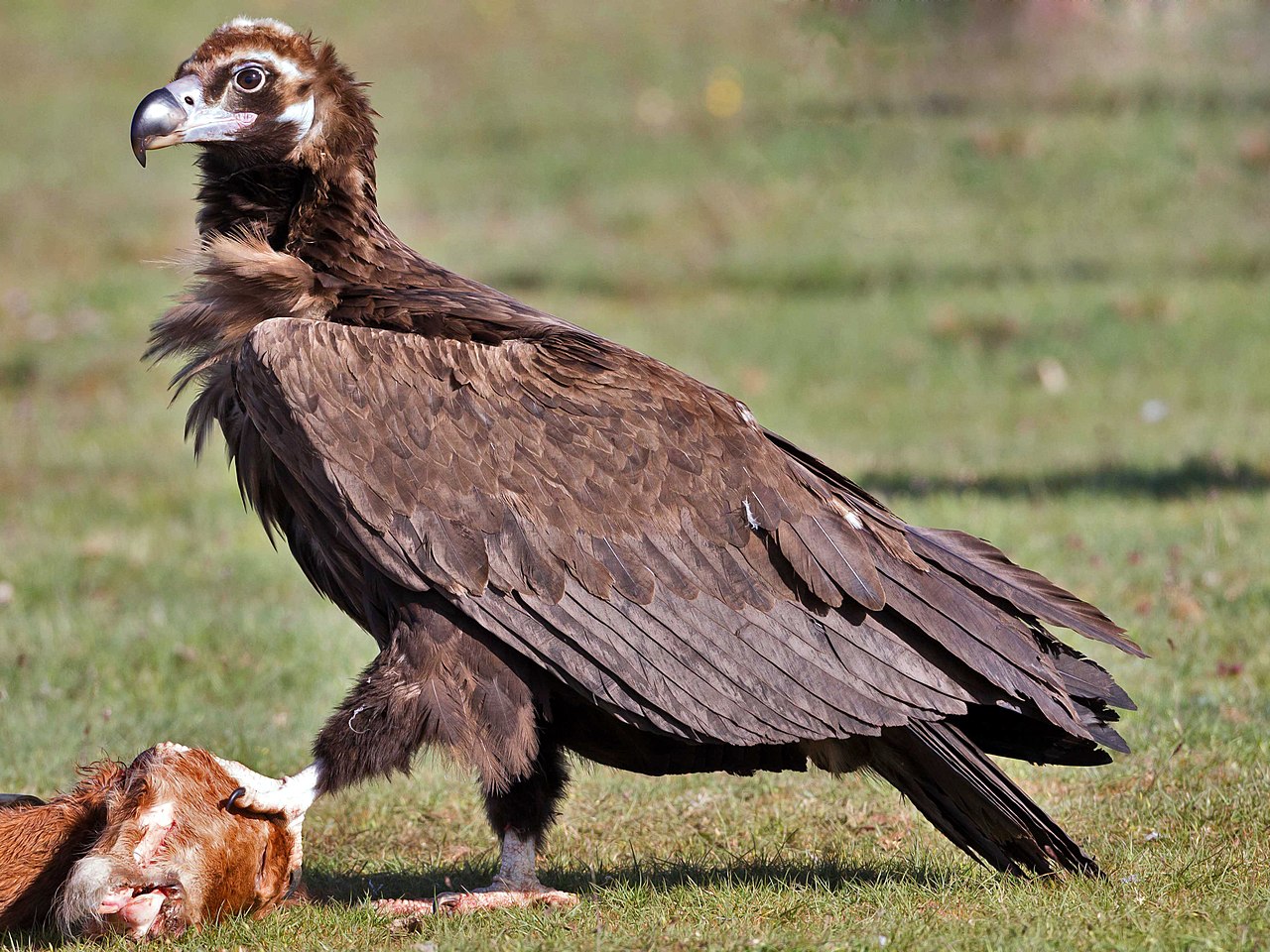
The cinereous vulture, also known as the black vulture, Eurasian black vulture, and monk vulture, is a very large raptor in the family Accipitridae distributed through much of temperate Eurasia. With a body length of 1.2 m, 3.1 m (10 ft) across the wings and a maximum weight of 14 kg (31 lb), it is the largest Old World vulture and largest member of the family Accipitridae.
Region
Temperate Eurasia
Typical Environment
Found from the Iberian Peninsula across the Caucasus, Central Asia, and into Mongolia and northern China. It favors open or semi-open landscapes with nearby woodlands for nesting, including montane steppe, scrub, and open pine or oak forests. The species typically nests in large trees, but may use cliffs in parts of Central Asia. It ranges widely while foraging, often covering tens of kilometers in a day.
Altitude Range
Sea level to 4500 m
Climate Zone
Temperate
Ease of Keeping
Beginner friendly: 1/5
Also called the Eurasian black vulture or monk vulture, it is among the largest flying birds in the world and the heaviest of the Old World vultures. It soars on broad wings to locate carrion using keen eyesight and often dominates other scavengers at carcasses. Conservation actions in parts of Europe have led to notable recoveries, including reintroductions and colony growth.


A portrait of the cinereous vulture, also known as the Eurasian black vulture

Flying over the snowy hillsides of Mongolia

Distribution in year 2007 * Green: Current resident breeding range. * Green ?: May still breed. * Green R: Re-introduction in progress. * Blue: Winter range; rare where hatched blue. * Dark grey: Former breeding range. * Dark grey ?: Uncertain former breeding range.

In Spain

In Israel

An egg

Six cinereous vultures with the smaller griffon vultures

A cinereous vulture feeding in Spain

A cinereous vulture flying over Mount Carmel on a rare visit in Israel (2016)

A cinereous vulture in Bird Paradise, Singapore
Temperament
solitary and territorial
Flight Pattern
soaring glider
Social Behavior
Generally nests singly or in loose colonies, constructing huge stick platforms in tall trees. Pairs are largely monogamous and lay a single egg, with both adults sharing incubation and chick-rearing. At carcasses it may gather with other vultures and can be dominant over smaller species.
Migratory Pattern
Partial migrant
Song Description
Usually silent in flight and at a distance. Around the nest or at carcasses it gives low grunts, hisses, and croaks rather than melodic calls.
Plumage
Mostly uniform dark brown to blackish with a shaggy ruff around the neck and a somewhat woolly appearance on the nape.
Diet
Primarily scavenges medium to large mammal carcasses, including wild ungulates and livestock. It can tear through tough hide and tendons with its powerful bill and may arrive later than more agile vultures to process dense tissues. Occasionally takes small live prey or carrion of birds and reptiles when available.
Preferred Environment
Forages over open country such as steppe, pasturelands, and arid foothills, often using rising thermals to cover large areas efficiently. Frequently associates with pastoral landscapes where livestock mortality provides carrion, and may visit managed feeding stations in some regions.


