

The chinstrap penguin is a penguin species that inhabits various islands and shores in the Southern Pacific and the Antarctic Oceans. Its name stems from the narrow black band under its head, which makes it appear as if it were wearing a black helmet. Due to its loud, harsh call, other common names include ringed penguin, bearded penguin, and stonecracker penguin.
Region
Antarctic and Subantarctic
Typical Environment
Breeds circumpolarly on islands and coasts around the Antarctic, including the South Shetland, South Orkney, South Sandwich, and South Georgia Islands, as well as the Antarctic Peninsula. Prefers ice-free rocky shores for nesting but forages widely over surrounding cold, nutrient-rich waters. Often concentrates near the pack-ice edge and shelf breaks where krill are abundant. Outside the breeding season, adults disperse at sea across the Southern Ocean but remain within cold polar and subpolar waters.
Altitude Range
Sea level to 200 m
Climate Zone
Polar
Ease of Keeping
Beginner friendly: 1/5
Chinstrap penguins are among the most numerous penguin species, breeding in vast, noisy colonies on ice-free slopes and beaches. They get their name from the narrow black band under the head that looks like a helmet strap. Pairs build nests from pebbles, which are often ‘stolen’ from neighbors. They are agile climbers and strong divers, regularly pursuing krill in dense flocks offshore.


Chinstrap penguin colony near Orne Harbor, Antarctic Peninsula
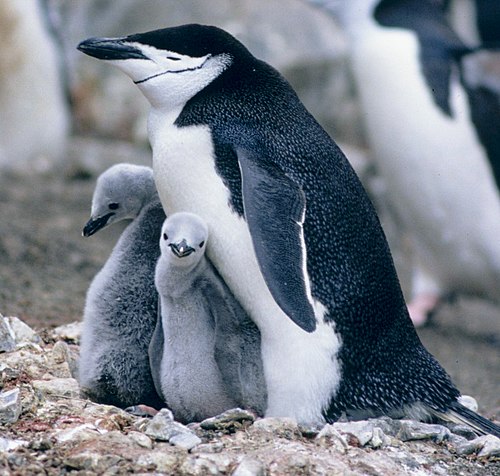
Adult with juveniles
Temperament
highly social and noisy
Flight Pattern
flightless; powerful underwater swimmer
Social Behavior
Breeds in dense colonies numbering thousands to tens of thousands of pairs. Generally monogamous within a season, with both parents incubating two eggs and sharing chick-rearing duties. Nests are built from small stones, and territorial disputes over pebbles are common. Chicks form crèches while adults commute to sea to forage.
Migratory Pattern
Seasonal migrant
Song Description
Vocalizations are loud, harsh, and rattling—earning the nickname ‘stonecracker.’ At nests, adults perform synchronized displays with braying calls and head swings. Contact calls help mates and chicks locate each other amid the colony din.
Plumage
Clean white face and underparts with a glossy black cap, nape, back, and flippers; neat, sharply defined color boundary. The signature thin black line runs from ear to ear beneath the chin. Flippers are dark above and white below; tail short and wedge-shaped.
Diet
Primarily feeds on Antarctic krill, supplemented by other small crustaceans and small fish when available. Forages by pursuit diving, often in coordinated groups that herd prey toward the surface. Typical dive depths range from tens to over 100 meters, with rapid, agile underwater maneuvers. Diet composition can shift with local prey availability and sea-ice conditions.
Preferred Environment
Usually feeds in cold offshore waters near the pack-ice edge, shelf breaks, and productive fronts. During breeding, many foraging trips occur within tens of kilometers of the colony, but adults may travel farther if prey is patchy.


