

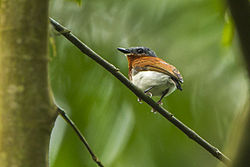
The chestnut wattle-eye is a species of bird in the family Platysteiridae. It is widespread across Central Africa. Its natural habitats are subtropical or tropical moist lowland forest, subtropical or tropical swamps, and moist savanna. It is often found on cocoa farms.
Region
Central Africa
Typical Environment
Occurs widely in lowland moist forests, swamp forests, gallery forests, and moist savannas across Central Africa, and extends into suitable secondary growth. It readily uses forest edges, riverine thickets, and shaded agroforestry such as cocoa farms. Typically forages in the understory and mid-story, often between 1–8 m above ground. It is generally sedentary, with local movements tracking food availability and habitat structure.
Altitude Range
Sea level to 1700 m
Climate Zone
Tropical
Ease of Keeping
Beginner friendly: 1/5
The chestnut wattle-eye belongs to the African flycatcher-like family Platysteiridae and is noted for the fleshy eye wattle used in visual displays. It often tolerates disturbed habitats and is frequently seen in cocoa agroforestry systems. Pairs perform wing-flicking and tail-twitching while foraging, and will join mixed-species flocks in forest understory.


Temperament
active and territorial
Flight Pattern
short rapid wingbeats between perches
Social Behavior
Usually seen in pairs or small family groups, maintaining territories within the understory. Builds a small cup nest placed in a fork or on a horizontal branch, typically low to mid-level. Frequently joins mixed-species flocks while foraging and uses wing- and tail-flick displays during pair interactions.
Migratory Pattern
Resident
Song Description
Song consists of clear, thin whistles delivered in brief phrases, often repeated from a concealed perch. Calls include sharp tiks and soft trills used to keep contact while foraging in dense cover.
Plumage
Compact, short-tailed bird with contrasting dark upperparts and rich chestnut on the underparts; often shows a small pale or white wing spot and clean belly. The face bears a conspicuous fleshy eye wattle. Females and immatures are duller and browner with less contrast.
Diet
Feeds primarily on small insects and other arthropods, including flies, beetles, caterpillars, and spiders. Captures prey by short sallies from low to mid-level perches and by hover-gleaning from foliage. Will occasionally snatch prey from vine tangles and dead leaf clusters, and may follow ant swarms opportunistically.
Preferred Environment
Forages in shaded understory and viney thickets of moist forest, swamp margins, and forest edge. Common in cocoa plantations and secondary growth where it works along mid-story branches and dense foliage.


