

The chestnut-rumped thornbill is a small passerine bird in the family Acanthizidae, endemic to Australia.
Region
Interior Australia
Typical Environment
Occurs widely across the arid and semi-arid interior, avoiding dense coastal forests and high-rainfall zones. Favors acacia (mulga) shrublands, mallee eucalypt country, chenopod and saltbush plains, and spinifex-dominated areas. Often near drainage lines and lightly timbered open country with scattered shrubs. Uses low vegetation strata for foraging and nesting.
Altitude Range
0–1200 m
Climate Zone
Arid
Ease of Keeping
Beginner friendly: 1/5
The chestnut-rumped thornbill is one of Australia’s arid-zone thornbills, easily recognized by its rich chestnut rump shown in flight. It forages in small, busy parties that often include family groups and sometimes mixes with other small insectivores. Pairs build a neat domed nest of grasses and bark, often low in shrubs. Populations are generally stable across suitable inland habitats.


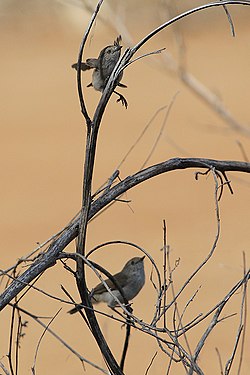
Chestnut-rumped thornbills posturing, (sequence of 5 photos in less than 2 seconds, Sturt Desert, NSW).

Chestnut-rumped thornbill (Sturt Desert, NSW).

Chestnut-rumped thornbill, about to fly off (Sturt Desert, NSW).

Chestnut-rumped thornbill, rear flight view (Sturt Desert, NSW).



Temperament
social and active
Flight Pattern
short rapid wingbeats with low, undulating flights
Social Behavior
Usually seen in pairs or small family parties that keep close to shrubs and low trees. Territorial during breeding, with some pairs assisted by helpers. Builds a compact domed nest of fine grasses and bark fibers, lined with softer material, placed low in shrubs or small trees.
Migratory Pattern
Resident
Song Description
Quiet, high-pitched trills and tinkling phrases delivered from low perches, interspersed with thin contact calls. Calls are rapid and conversational within the group, aiding cohesion while foraging in dense shrubs.
Plumage
Warm grey-brown upperparts with fine streaking on the crown and paler, lightly streaked underparts. Prominent rich chestnut rump and uppertail coverts contrast with otherwise brown tail showing whitish tips. Face is pale with a subtle eyebrow; overall appearance is small, compact, and finely marked.
Diet
Primarily small arthropods such as insects, spiders, and their larvae gleaned from foliage, twigs, and bark. Will occasionally take tiny seeds or honeydew, especially during dry periods. Foraging is methodical and close-range, often within a meter or two of the ground.
Preferred Environment
Feeds in low shrubs, spinifex clumps, and the outer foliage of small trees, sometimes dropping to the ground to pick prey. Frequently forages along ecotones where shrub cover is patchy and diverse.


