

The changeable hawk-eagle (Nisaetus cirrhatus) or crested hawk-eagle is a large bird of prey species of the family Accipitridae. More informal or antiquated English common names include the marsh hawk-eagle or Indian crested hawk-eagle. It is a member of the subfamily Aquilinae, with signature feathers, absent in tropical raptors from outside this subfamily, covering the tarsus. It was formerly placed in the genus Spizaetus, but studies pointed to the group being paraphyletic resulting in the Old World members being placed in Nisaetus and separated from the New World species. It is a typical "hawk-eagle" in that it is an agile forest-dwelling predator and like many such eagles readily varies its prey selection between birds, mammals or reptiles as well as other vertebrates. Among the members of its genus, the changeable hawk-eagle stands out as the most widely distributed, adaptable and abundant species. Individuals show a wide range of variation in plumage from pale to dark, varying with moult and age giving rise to the name "changeable".
Region
South and Southeast Asia
Typical Environment
Occurs across the Indian Subcontinent through Myanmar and Indochina to parts of the Sundaic region. It favors tropical and subtropical forests, including evergreen and moist deciduous types, and tolerates edges, degraded woodland, and plantations near natural cover. Often seen along ridgelines, riverine corridors, and forest clearings where soaring is aided by thermals. Locally uses fragmented habitats so long as tall nest trees and hunting perches remain.
Altitude Range
Sea level to 2200 m
Climate Zone
Tropical
Ease of Keeping
Beginner friendly: 1/5
Also called the crested hawk-eagle, this agile forest raptor shows striking variation in plumage from pale to very dark, which inspired the name 'changeable'. It has fully feathered tarsi, a hallmark of the Aquilinae, and a prominent, erect crest. Formerly placed in Spizaetus, it is now in Nisaetus after genetic studies split Old and New World lineages. It readily takes a wide range of vertebrate prey, from birds and small mammals to reptiles, and sometimes raids poultry near villages.

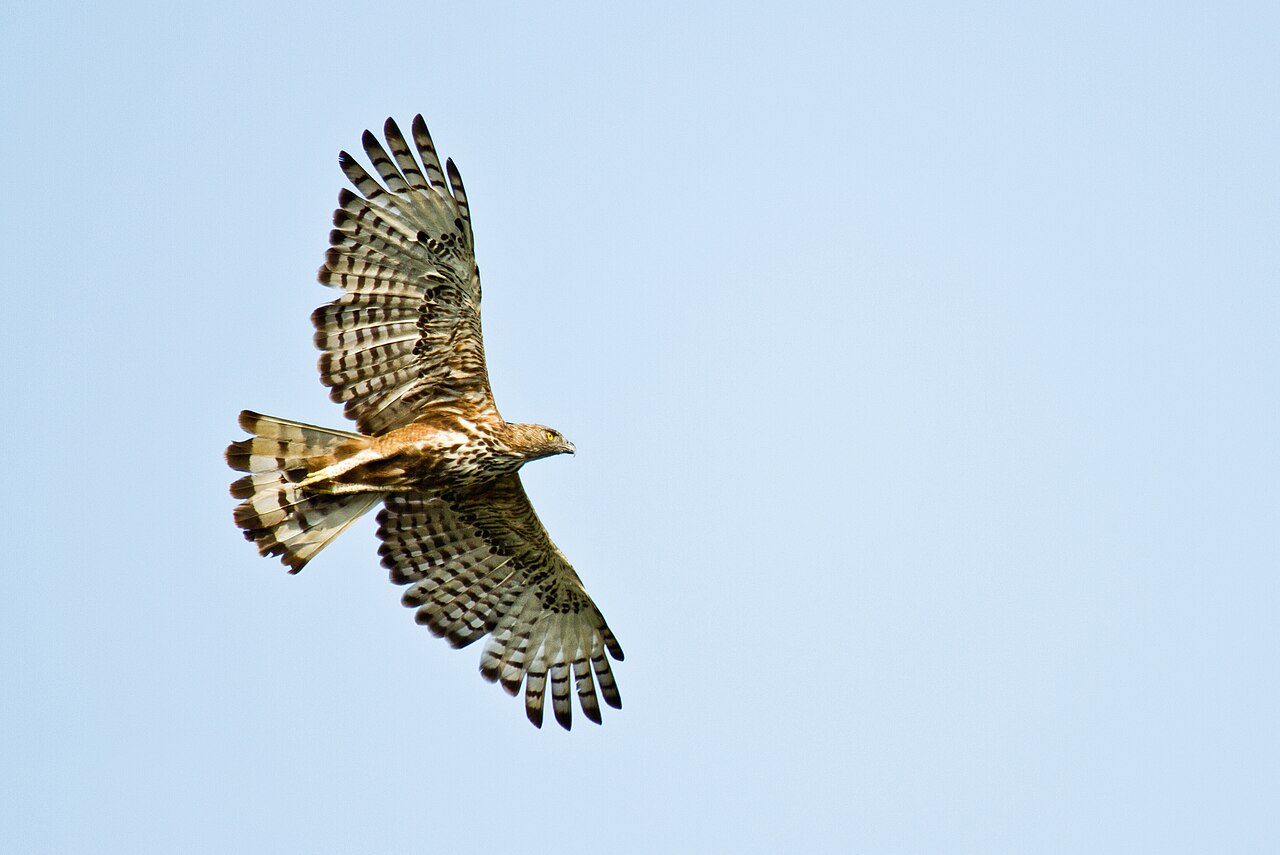
In flight, changeable hawk-eagles have distinctly short but broad wings with dark barring on flight feathers and a long tail.

A crestless changeable hawk-eagle (N. c. limnaeetus) in Singapore.

A crestless rare dark morph in flight in Sunderbans National Park

A juvenile in Bundala National Park


The formidable talons of the changeable hawk-eagle

Changeable hawk-eagle eating an egret in Sri Lanka

Changeable hawk-eagle with Indian garden lizard in Satpura National Park

Changeable hawk-eagle eating a monitor lizard in Maharashtra
Temperament
solitary and territorial
Flight Pattern
soaring glider with powerful flap-soar sequences
Social Behavior
Typically seen alone or as pairs; pairs maintain territories year-round. Nests are large stick platforms placed high in tall trees, used for successive seasons. Usually lays a single egg, with prolonged parental care and fierce nest defense. Courtship includes high circling and steep dives with calling.
Migratory Pattern
Resident
Song Description
Vocal for a large eagle, giving high-pitched whistles and sharp, ringing screams. Display flights are accompanied by repetitive, piercing calls that carry over forest canopies.
Plumage
Highly variable; from pale, streaked underparts with brown upperparts to dark morph birds with dusky underparts. Tail broadly banded; underparts often show bold streaking or blotching. Tarsi are fully feathered and a long, erect crest is usually conspicuous. Juveniles are paler with more buff and white, and finer streaking.
Diet
An opportunistic predator that takes medium-sized birds (pigeons, junglefowl, mynas), small to medium mammals (squirrels, bats, young macaques), and reptiles (lizards, snakes). Hunts from concealed perches with swift surprise strikes or by soaring and stooping along forest edges. Will occasionally take domestic poultry near settlements. Prey size is often matched to cover and hunting vantage points.
Preferred Environment
Forages along forest edges, clearings, riverbanks, and over broken canopy where visibility is good. Often uses tall emergent trees as vantage points and patrols ridgelines on thermals. In human-modified landscapes, hunts in plantations adjacent to remnant forest.


