
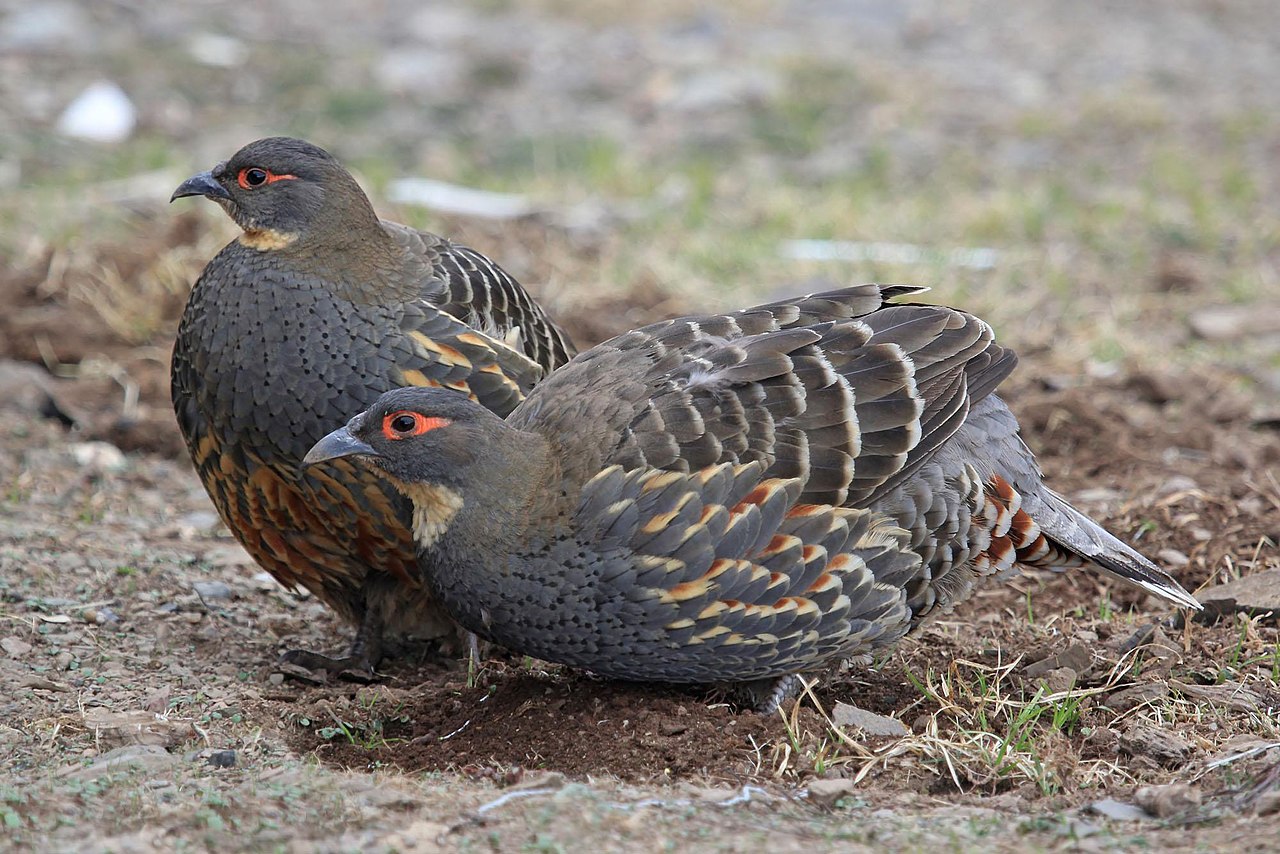
Buff-throated monal-partridge, also known as buff-throated partridge or Szechenyi's monal-partridge, is a member of the family Phasianidae in the order Galliformes. It is endemic to western China.
Region
Southeastern Tibetan Plateau
Typical Environment
Occupies subalpine and montane conifer forests dominated by spruce, fir, and juniper, typically with dense rhododendron or bamboo undergrowth. Frequents forest edges, alpine shrublands, and rocky slopes near treeline, using thickets for cover. In winter it often shifts to slightly lower, south-facing slopes where snow cover is lighter. The species roosts in trees and forages mainly on the forest floor, scratching through leaf litter and soft soil. It tolerates cold, snowy conditions but relies on dense understory for protection.
Altitude Range
3000–4600 m
Climate Zone
Highland
Ease of Keeping
Beginner friendly: 1/5
Also called Szechenyi's monal-partridge, this high-elevation pheasant-relative is confined to the southeastern Tibetan Plateau of western China. It often roosts in trees—a useful adaptation for avoiding ground predators in snowy habitats. Pairs or family groups keep close contact with clear, whistled calls and make short uphill dashes when disturbed. The species performs seasonal altitudinal shifts but does not undertake long-distance migrations.


Temperament
shy and wary
Flight Pattern
short rapid wingbeats with brief glides
Social Behavior
Usually seen in pairs or small family parties, forming loose coveys outside the breeding season. Ground-nesting in concealed sites under shrubs or roots; clutch size is small and both adults may attend the brood. Territorial during breeding, with close pair bonds maintained by contact calls.
Migratory Pattern
Resident
Song Description
Clear, whistled notes often given in sequences, carrying well through conifer forest. Pairs may exchange antiphonal whistles; alarm calls are harsher and more rapid.
Plumage
Overall finely scaled brown and grey upperparts with barred flanks; throat and upper breast are warm buff bordered by darker markings. The head is grey-brown with a pale supercilium and subtle facial patterning. Tail is long and graduated with dusky barring; plumage is dense and well-suited to cold, high-altitude climates.
Diet
Forages on shoots, buds, leaves, berries, and seeds, supplemented by bulbs and roots dug from soft soil. Takes invertebrates such as beetles, ants, and other insects when available, especially in spring and summer. In winter, relies more heavily on evergreen foliage, seeds, and stored energy reserves.
Preferred Environment
Feeds mostly on the forest floor along edges, clearings, and under dense rhododendron or bamboo. Often scratches through leaf litter and shallow soil and may probe in snow near exposed patches.


