

The buff-necked ibis, also known as the white-throated ibis, is a fairly large ibis found widely in open habitats of eastern and northern South America. It formerly included the similar black-faced ibis as a subspecies, but that species is almost entirely restricted to colder parts of South America, has a buff lower chest, and lacks the contrasting large white wing-patches.
Region
Northern and Eastern South America
Typical Environment
Occurs widely east of the Andes from the Llanos of Colombia and Venezuela through the Guianas and much of Brazil to eastern Bolivia, Paraguay, Uruguay, and northern Argentina. It favors open habitats such as seasonally flooded savannas, marsh edges, riverbanks, wetlands, pastures, and agricultural fields. The species avoids dense forest interiors but readily uses open woodlands and gallery forest margins. It adapts well to human-modified landscapes where shallow water or soft soils are available.
Altitude Range
0–1500 m
Climate Zone
Tropical
Ease of Keeping
Beginner friendly: 1/5
The buff-necked ibis, also called the white-throated ibis, is a conspicuous wader of open country in northern and eastern South America. It shows striking white wing patches in flight and a warm buff head and neck that give the species its name. It often forages in cattle pastures, taking advantage of disturbed soil and flushed prey, and is frequently detected by its loud, trumpeting calls. It formerly included the southern black-faced ibis as a subspecies, now treated as a separate species.


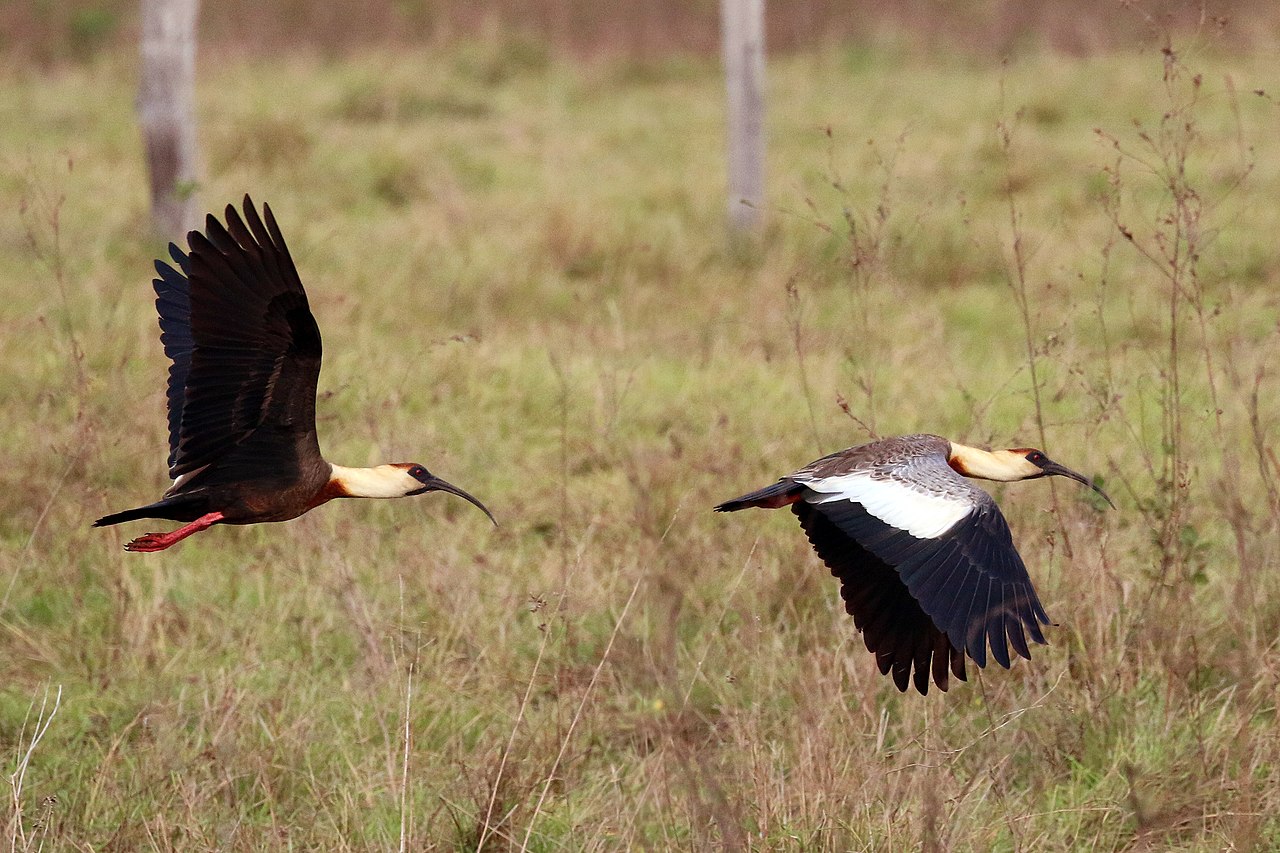
In flight, Pantanal, Brazil (composite image)
Temperament
social and alert
Flight Pattern
strong flier with steady wingbeats and occasional glides, neck extended
Social Behavior
Typically seen in pairs, family groups, or small flocks, especially in feeding areas and at communal roosts. Breeds in loose colonies or scattered pairs, often nesting in trees or tall shrubs near water. Nests are platform-like structures of sticks lined with softer material. Pairs are attentive, sharing incubation and chick rearing.
Migratory Pattern
Resident
Song Description
Loud, trumpeting honks and braying calls that carry over long distances. Calls are given during flight, at roosts, and when alarmed, often in rhythmic series. Vocalizations help maintain contact within pairs and flocks.
Plumage
Buff head and neck with a whitish throat, gray to brownish upperparts, and darker underparts. Large white patches on the upperwings contrast with dark flight feathers, especially obvious in flight. Long, decurved bill and bare facial skin give a distinctive ibis profile.
Diet
Feeds mainly on invertebrates such as beetles, grasshoppers, larvae, earthworms, snails, and crabs, and will also take small vertebrates like frogs and lizards. Probes soft soil, mud, or shallow water with its long curved bill, using touch to locate prey. Often forages in recently flooded areas or behind grazing livestock that flush insects.
Preferred Environment
Open, damp ground including wet pastures, marsh margins, riverbanks, rice fields, and seasonally flooded savannas. It selects areas with short vegetation and soft substrates that are easy to probe.


