
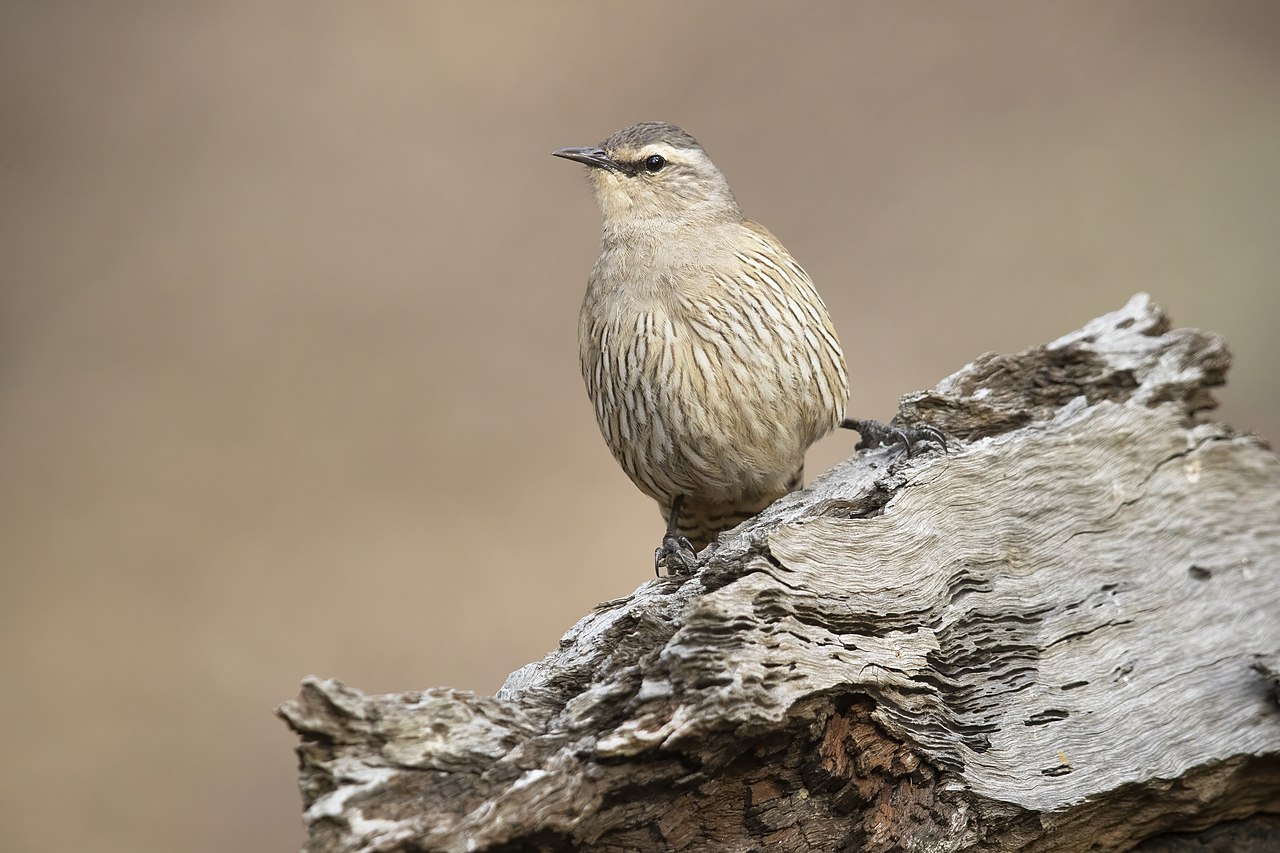
The brown treecreeper is the largest Australasian treecreeper. The bird, endemic to eastern Australia, has a broad distribution, occupying areas from Cape York, Queensland, throughout New South Wales and Victoria to Port Augusta and the Flinders Ranges, South Australia. Prevalent nowadays between 16˚S and 38˚S, the population has contracted from the edges of its pre-European range, declining in Adelaide and Cape York. Found in a diverse range of habitats varying from coastal forests to mallee shrub-lands, the brown treecreeper often occupies eucalypt-dominated woodland habitats up to 1,000 metres (3,300 ft), avoiding areas with a dense shrubby understorey.
Region
Eastern and southeastern Australia
Typical Environment
Occurs from northeastern Queensland south through New South Wales and Victoria to eastern South Australia, with the strongest presence in eucalypt-dominated woodlands. It uses coastal forests, open woodlands, riparian corridors, and mallee, but generally avoids areas with dense shrubby understorey. The species favors landscapes with large, mature trees, rough bark, and abundant dead and fallen timber for foraging and nesting. It is most common in relatively intact woodland mosaics and along edges with scattered trees. Local distribution has contracted from heavily cleared and urbanized zones.
Altitude Range
Sea level to 1000 m
Climate Zone
Temperate
Ease of Keeping
Beginner friendly: 1/5
The brown treecreeper is the largest Australasian treecreeper and is specialized for climbing trunks and branches in search of invertebrates. It is a cooperative breeder, with family groups often including helpers from previous broods. The species depends on mature eucalypt woodlands with standing and fallen timber, and declines where understorey becomes dense or dead wood is removed. Habitat fragmentation has led to local contractions despite a broad historical range.


Brown treecreeper foraging on a tree

Temperament
social and active
Flight Pattern
short rapid wingbeats with bounding, undulating flights between trees
Social Behavior
Usually found in small family groups that maintain territories year-round. A cooperative breeder, with helpers assisting a breeding pair at cavity nests in tree hollows. Pairs and groups forage together, moving methodically along trunks, branches, and the ground.
Migratory Pattern
Resident
Song Description
Calls are clear, piping notes and quick trills exchanged among group members, often given in contact sequences. Song includes short, melodious phrases with descending whistles, carrying well through open woodland.
Plumage
Warm brown upperparts with paler buff underparts marked by dusky scalloping; slightly rufous tones on wings and flanks. Feathers are soft and closely set, aiding stealthy climbing. Subtle pale throat and mottled breast contrast with darker wings and tail.
Diet
Primarily feeds on arthropods such as ants, beetles, termites, caterpillars, and spiders, gleaned from bark crevices, branches, fallen logs, and leaf litter. It probes and flicks bark, often prying at loose flakes, and also forages frequently on the ground near logs. Occasional small seeds or nectar may be taken, but animal prey dominates.
Preferred Environment
Most often forages in mature eucalypt woodlands with rough-barked trees and abundant dead wood. Frequently searches along trunks, branches, stumps, and fallen logs, and edges of clearings where sparse understorey eases movement.


