

The brown pelican is a bird of the pelican family, Pelecanidae, one of three species found in the Americas and one of two that feed by diving into water. It is found on the Atlantic Coast from New Jersey to the mouth of the Amazon River, and along the Pacific Coast from British Columbia to Peru, including the Galapagos Islands. The nominate subspecies in its breeding plumage has a white head with a yellowish wash on the crown. The nape and neck are dark maroon–brown. The upper sides of the neck have white lines along the base of the gular pouch, and the lower fore neck has a pale yellowish patch. The male and female are similar, but the female is slightly smaller. The nonbreeding adult has a white head and neck. The pink skin around the eyes becomes dull and gray in the nonbreeding season. It lacks any red hue, and the pouch is strongly olivaceous ochre-tinged and the legs are olivaceous gray to blackish-gray.
Region
Atlantic and Pacific coasts of the Americas
Typical Environment
Inhabits coastal marine environments, especially sheltered nearshore waters such as estuaries, bays, lagoons, and harbors. Prefers barrier islands, mangrove islets, sand spits, and coastal cliffs for roosting and nesting. Common along the Gulf of Mexico and Caribbean, the Atlantic from the mid-Atlantic U.S. south to the Amazon mouth, and the Pacific from British Columbia to Peru, including the Galápagos. Rarely ventures far inland and typically remains within a few kilometers of shore while foraging.
Altitude Range
Sea level to 100 m
Climate Zone
Subtropical
Ease of Keeping
Beginner friendly: 1/5
The brown pelican is famous for its dramatic plunge-dives, folding its wings and dropping from the air to scoop fish with its expandable throat pouch. Once severely affected by DDT, it has rebounded strongly after pesticide bans and conservation measures. It often glides low over waves in ground effect and readily uses piers, jetties, and boats as roosts.


Close up of a P. o. murphyi from the Parque de las Leyendas, in Lima, Peru

Brown pelican, Pelecanus occidentalis
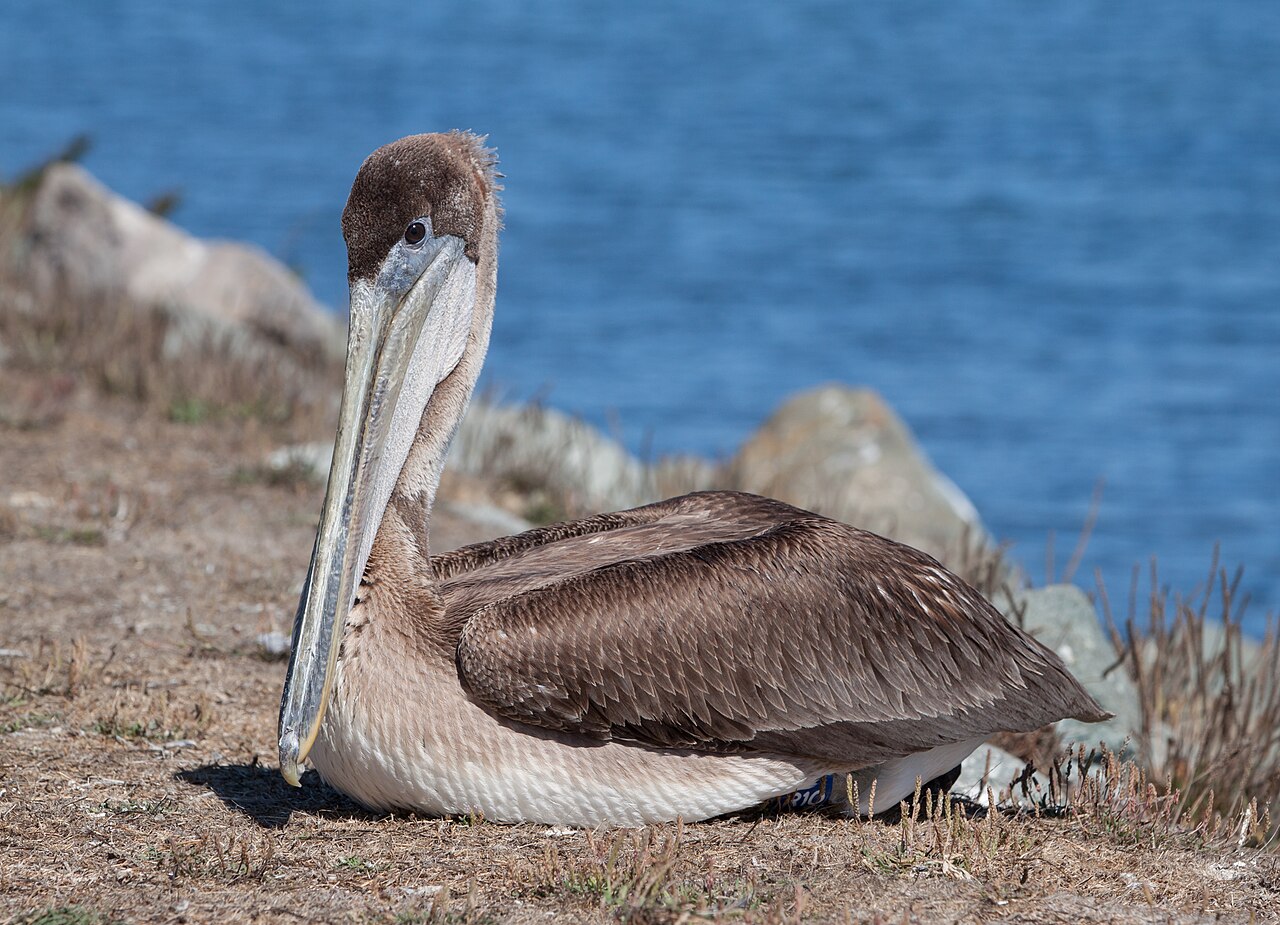
Juvenile at Bodega Harbor, California, United States

immature P. o. carolinensis, Panama

Diving

California brown pelican half-submerged after a dive

Flock of California brown pelicans feeding in waters off San Diego, California


A brown pelican visits the Huntington Beach, CA pier.

Flag of Louisiana prominently displaying the brown pelican

The brown pelican appears atop the coat of arms of Sint Maarten

Aerial view of the Pelican Island National Wildlife Refuge
Temperament
social and gregarious
Flight Pattern
soaring glider with strong, steady wingbeats; often skims wave troughs
Social Behavior
Highly colonial, nesting on isolated islands, mangroves, or low shrubs and ground sites safe from predators. Pairs are seasonally monogamous; both sexes build the nest, incubate, and feed chicks by regurgitation. Roosts communally on sandbars, docks, and piers.
Migratory Pattern
Partial migrant
Song Description
Generally quiet; adults give low grunts, croaks, and hisses at colonies or during disputes. Chicks produce loud begging calls at the nest.
Plumage
Bulky, brownish-gray body with pale streaking; long neck and massive bill with large gular pouch. Breeding adults show a white head with yellowish wash on the crown and a dark maroon-brown nape and neck; nonbreeding adults have a whiter head and neck. Juveniles are uniformly brown above with a paler, often whitish belly.
Diet
Primarily small schooling fish such as menhaden, anchovies, sardines, and mullet. Employs plunge-diving from several meters up, using the pouch to scoop prey and then draining water before swallowing. Occasionally takes crustaceans and opportunistically follows fishing vessels or forages near feeding dolphins.
Preferred Environment
Feeds in shallow nearshore waters, estuaries, tidal channels, and around jetties, reefs, and harbors. Often forages just beyond the surf line or within bays where baitfish concentrate.


