

Bonaparte's gull is a member of the gull family Laridae found mainly in northern North America. At 28 to 38 cm in length, it is one of the smallest species of gull. Its plumage is mainly white with grey upperparts. During breeding season, Bonaparte's gull gains a slaty-black hood. The sexes are similar in appearance.
Region
North America
Typical Environment
Breeds across boreal Canada and Alaska, typically around forested lakes, bogs, and slow-moving rivers. In winter it moves to coastal North America, from the Pacific Northwest and California to the Atlantic seaboard and Gulf of Mexico. It also uses large inland lakes and rivers during migration. Occasional vagrants reach Europe and East Asia. Frequently seen around harbors, estuaries, and river mouths, especially where currents concentrate food.
Altitude Range
Sea level to 1500 m
Climate Zone
Temperate
Ease of Keeping
Beginner friendly: 1/5
One of the smallest gulls, it has a delicate, tern-like flight and often feeds by picking insects off the water’s surface. Unusually for a gull, it nests in trees within boreal forests. In breeding plumage it shows a slaty-black hood; in winter this is replaced by a neat black ear-spot. The species is named after the ornithologist Charles Lucien Bonaparte.


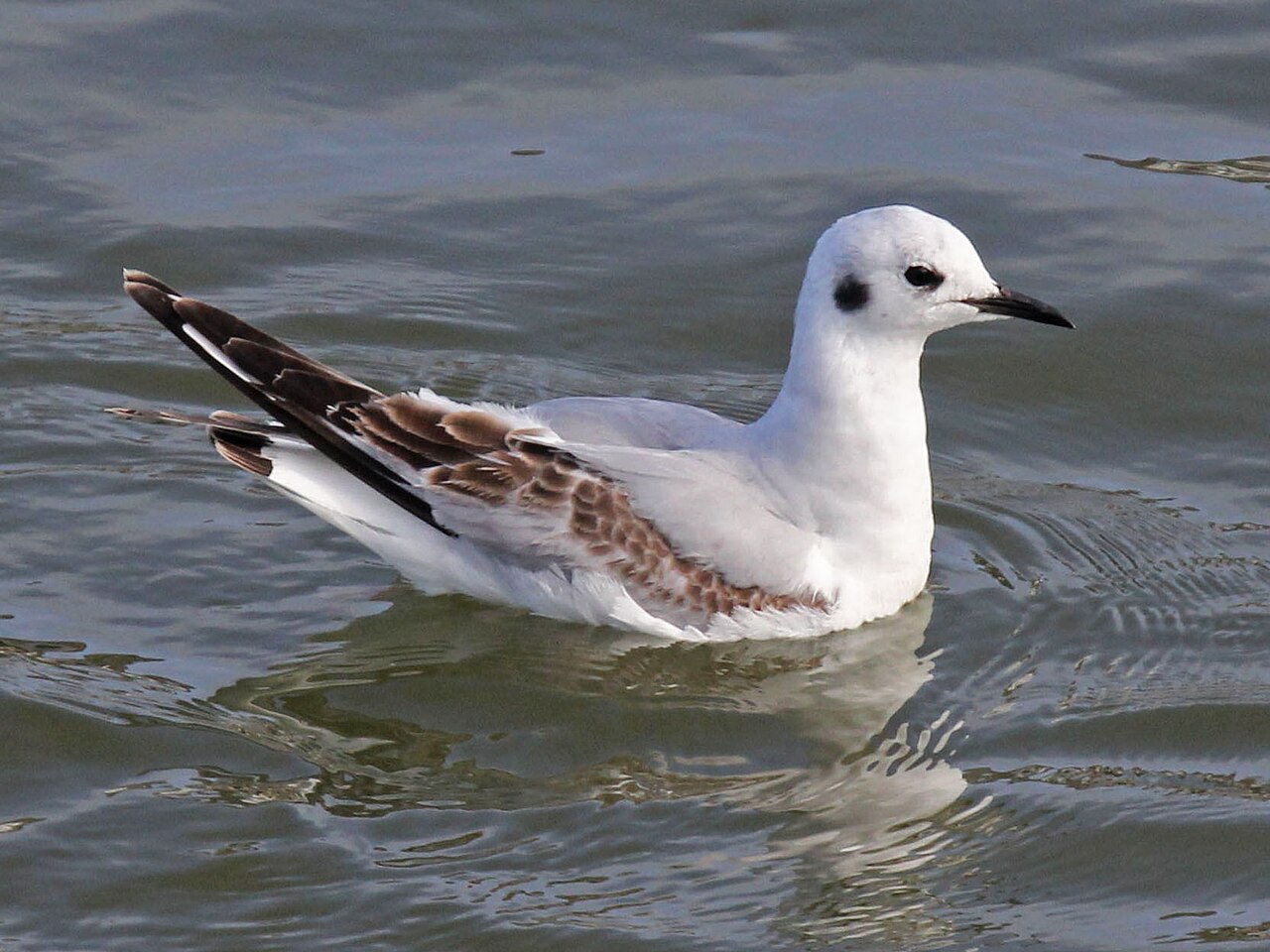
Bonaparte's gull in immature (first-winter) plumage, showing the tail band and brown wing pattern cited in Ord's description of the species

Bonaparte's gull in fresh juvenile plumage; Whitehorse, Yukon

A Bonaparte's Gull eats a sandworm in the Saco Bay, ME.

Once they leave the nest, chicks follow their parents to the nearest water.

Bonaparte's gull nesting at the top of a black spruce in Churchill, Manitoba



Temperament
social and active
Flight Pattern
buoyant, tern-like flight with quick, agile wingbeats and hovering
Social Behavior
Often forms flocks during migration and winter, frequently mixing with other small gulls and terns. Breeds colonially, unusually nesting in conifer trees over water; pairs are seasonally monogamous and both sexes tend the nest. Courtship includes aerial chases and ritualized calls and postures.
Migratory Pattern
Seasonal migrant
Song Description
Voice is high-pitched and thin, with sharp kik and klee-eek notes reminiscent of a small tern. Calls are frequent over breeding colonies and softer, squeaky contact calls are used while foraging.
Plumage
Mainly white with pale grey upperparts and blackish wing tips; in breeding, a smooth slaty-black hood contrasts with white underparts and a pale grey mantle. Nonbreeding birds lose the hood, showing a clean white head with a distinct black ear-spot. The wings show a neat white wedge in the primaries in flight.
Diet
In the breeding season it takes a high proportion of flying and aquatic insects, often snatching them from the air or water surface. Outside the breeding season it adds small fish, crustaceans, marine worms, and other invertebrates. It will occasionally scavenge but does so far less than larger gulls, favoring active foraging.
Preferred Environment
Feeds over lakes, ponds, rivers, estuaries, and sheltered coastal waters, especially near current seams and outfalls that concentrate prey. Often forages just above the surface, picking items with deft maneuvers, and may work shorelines, mudflats, and harbor edges.


