
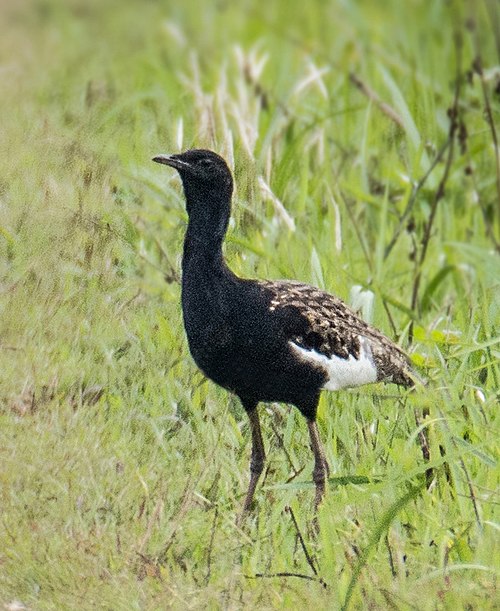
The Bengal florican, also called the Bengal bustard, is a bustard species native to the Indian subcontinent, Cambodia, and Vietnam. It is listed as Critically Endangered on the IUCN Red List because fewer than 1,000 individuals were estimated to be alive as of 2017. It is the only member of the genus Houbaropsis.
Region
Indo-Gangetic Plains and Mekong floodplains
Typical Environment
This species occupies tall, seasonally flooded alluvial grasslands and wet meadows in the Terai of Nepal and northern India (notably Uttar Pradesh and Assam), and on the Tonle Sap floodplain of Cambodia with small remnants in southern Vietnam. It prefers mosaics of dense grasses with scattered shrubs and open patches for displaying. During monsoon flooding it shifts to slightly higher, drier ground or recently burned/harvested fields. Historically more widespread, it now persists in fragmented pockets near protected areas and community-managed grasslands.
Altitude Range
0–300 m
Climate Zone
Tropical
Ease of Keeping
Beginner friendly: 1/5
The Bengal florican is the only member of its genus and is famed for the male’s spectacular breeding display of vertical leaps and fluttering flights above tall grass. It depends on seasonally inundated grasslands that are rapidly disappearing to agriculture and development. Community-managed grasslands in Cambodia and protected reserves in India and Nepal are central to ongoing conservation efforts.


Bengal florican at Orang National Park, Assam, India

Female at Manas National Park
Temperament
wary and secretive
Flight Pattern
short rapid wingbeats with brief glides; explosive flushes from cover
Social Behavior
Generally solitary or in loose pairs outside the breeding season. Males are polygynous and perform dramatic aerial display flights and vertical leaps over territories in tall grass. Nests are simple ground scrapes hidden in dense vegetation, typically with 1–2 eggs; the female alone incubates and cares for the young.
Migratory Pattern
Partial migrant
Song Description
Usually quiet, but displaying males give harsh croaks and buzzing notes audible over the grasslands. Contact calls are low, guttural clucks or grunts, with alarm calls given as abrupt, rasping sounds.
Plumage
Males in breeding plumage show a striking contrast of black head, neck, and underparts with bright white wing coverts and a buff-brown, finely barred back. Females and non-breeding males are cryptically patterned with buff and brown streaking, aiding concealment in tall grass.
Diet
Feeds on large insects such as grasshoppers, crickets, and beetles, supplemented by seeds, tender shoots, and flowers. It also takes small vertebrates and other invertebrates opportunistically. Diet varies seasonally with monsoon cycles and local land use, often exploiting recently burned or cut fields.
Preferred Environment
Forages on foot in tall and medium-height grasslands, the edges of wetlands, fallow fields, and lightly grazed pastures. It favors a mosaic of cover and open patches where it can both conceal itself and scan for prey.


