

The Arfak astrapia is a species of astrapia, a group of birds found in the birds-of-paradise family Paradiseidae.
Region
New Guinea (Bird's Head/Arfak Mountains, West Papua, Indonesia)
Typical Environment
This species inhabits montane and upper-montane forests, especially mossy cloud forests with dense epiphytes and fruiting trees. It frequents forest edges, ridgelines, and gaps where fruit is abundant, and will also use secondary growth adjacent to intact forest. Individuals often move along canopy and midstory strata, occasionally descending to lower levels for foraging. It relies on structurally complex, humid forest with a high diversity of fruiting plants.
Altitude Range
1500–2800 m
Climate Zone
Highland
Ease of Keeping
Beginner friendly: 1/5
The Arfak astrapia is a bird-of-paradise found only in the Arfak and adjacent mountains of the Bird’s Head Peninsula in West Papua, Indonesia. Males have long, elegant tails and iridescent sheen used in courtship displays, while females are more cryptically colored. Like many birds-of-paradise, males display at traditional sites and the female alone builds the nest and raises the young.


Astrapia nigra. Museum specimen
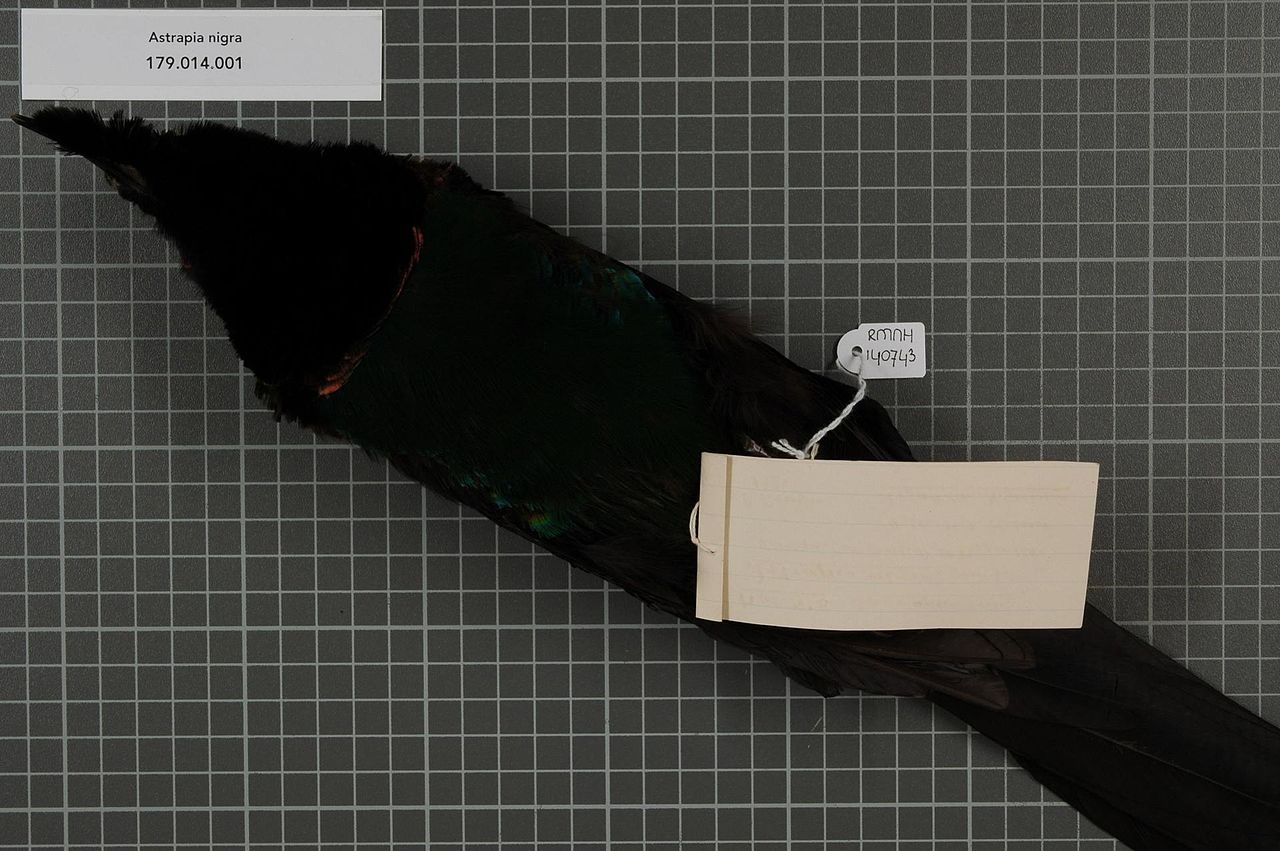
Male Arfak Astrapia specimen at the Naturalis Biodiversity Center.
Temperament
solitary and secretive
Flight Pattern
short rapid wingbeats with direct, bounding flights between perches
Social Behavior
Usually seen alone or in loose pairs; males maintain dispersed display sites where they perform upright postures and tail fanning to attract females. The species is polygynous; the female alone builds a cup nest and raises the young. Courtship and display activity increases when fruit is abundant.
Migratory Pattern
Resident
Song Description
Vocalizations are a series of harsh, rasping calls and buzzing notes, interspersed with sharp chups. During display, males add louder, more emphatic calls that carry through the montane forest.
Plumage
Male is velvety black with strong iridescent green to bronze sheen on the head, upperparts, and breast, and a very long, graduated black tail. Female is brown to rufous-brown with barred or streaked underparts and a shorter tail, providing excellent camouflage. Both sexes have a relatively stout, straight bill and dark legs.
Diet
Primarily feeds on a variety of forest fruits and berries, especially drupes from canopy trees. It supplements its diet with arthropods gleaned from foliage, bark, and epiphytes. Foraging often involves careful perch-and-pluck movements and short sallies within the midstory and canopy.
Preferred Environment
Most often forages in the mid to upper canopy of mossy montane forest and along fruiting edges and ridgelines. It also uses forest gaps and secondary growth where fruiting plants are concentrated.


