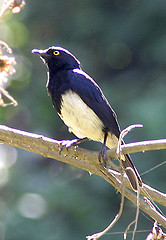
Abbott's babbler is a species of bird in the family Pellorneidae. It is widely distributed along the Himalayas in South Asia and extending into the forests of Southeast Asia. They are short-tailed and stout birds which forage in pairs in dense undergrowth close to the ground and their presence is indicated by their distinctive calls.
Region
South and Southeast Asia
Typical Environment
Found from the Himalayan foothills through mainland Southeast Asia to the Malay Peninsula, Sumatra, and Borneo. It inhabits lowland and foothill evergreen forests, secondary growth, forest edge, and bamboo thickets. The species keeps to dense undergrowth, vine tangles, and thickets along streams and trails. It tolerates moderate disturbance if a shaded, shrubby understory remains. In many areas it is common but easily overlooked due to its secretive habits.
Altitude Range
Sea level to 1500 m
Climate Zone
Tropical
Ease of Keeping
Beginner friendly: 1/5
Abbott's babbler is a shy understory specialist known for its loud, antiphonal duets given by pairs from dense cover. It is a short-tailed, stout babbler that spends most of its time close to the ground, where it forages methodically. Several subspecies occur across its wide range, showing subtle differences in tone and size. Its presence often indicates intact, well-vegetated forest understory.


Head showing the strong bill

By John Gerrard Keulemans
Temperament
secretive and skulking
Flight Pattern
short rapid wingbeats, usually low and weak flight
Social Behavior
Typically found in pairs or small family groups that maintain close contact with duets. Nests are cup-shaped and placed low in dense vegetation or among roots and fronds. Territories are defended vocally, and pairs often move together while foraging.
Migratory Pattern
Resident
Song Description
A loud, ringing series of clear whistles, often delivered antiphonally by a pair. Phrases are repeated and carry well through dense vegetation. Calls include sharp chips and scolds when alarmed.
Plumage
Upperparts warm olive-brown to rufescent-brown with a smooth, plain texture; underparts buffy to greyish with a paler throat. The tail is short and rounded, and the face shows a slightly greyer wash. Feathers appear soft and sleek without strong barring or spotting.
Diet
Primarily feeds on insects and other small invertebrates such as beetles, ants, spiders, and caterpillars. It gleans from leaves, twigs, and the forest floor, frequently probing leaf litter and turning over debris. Occasional small berries or seeds may be taken, especially when invertebrate prey is scarce.
Preferred Environment
Forages in dense understory, bamboo clumps, and along shaded forest edges. It often keeps near the ground along stream banks, paths, and tangles where cover is thick. Uses low perches to scan and then drops to the ground to pick prey.